Advanced Course Voucher
Self-Paced, Virtual, or In-Person · 14 CEUs
Black Friday pricing ends Monday, November 30.

Take the next step after Essential Training. Advanced Training highlights the Graston Technique therapy examination and treatment approach for musculoskeletal dysfunction and mechanical pain. Build on your foundational skills with advanced instrument-assisted soft tissue mobilization techniques, movement-based interventions, and five new advanced treatment strokes.
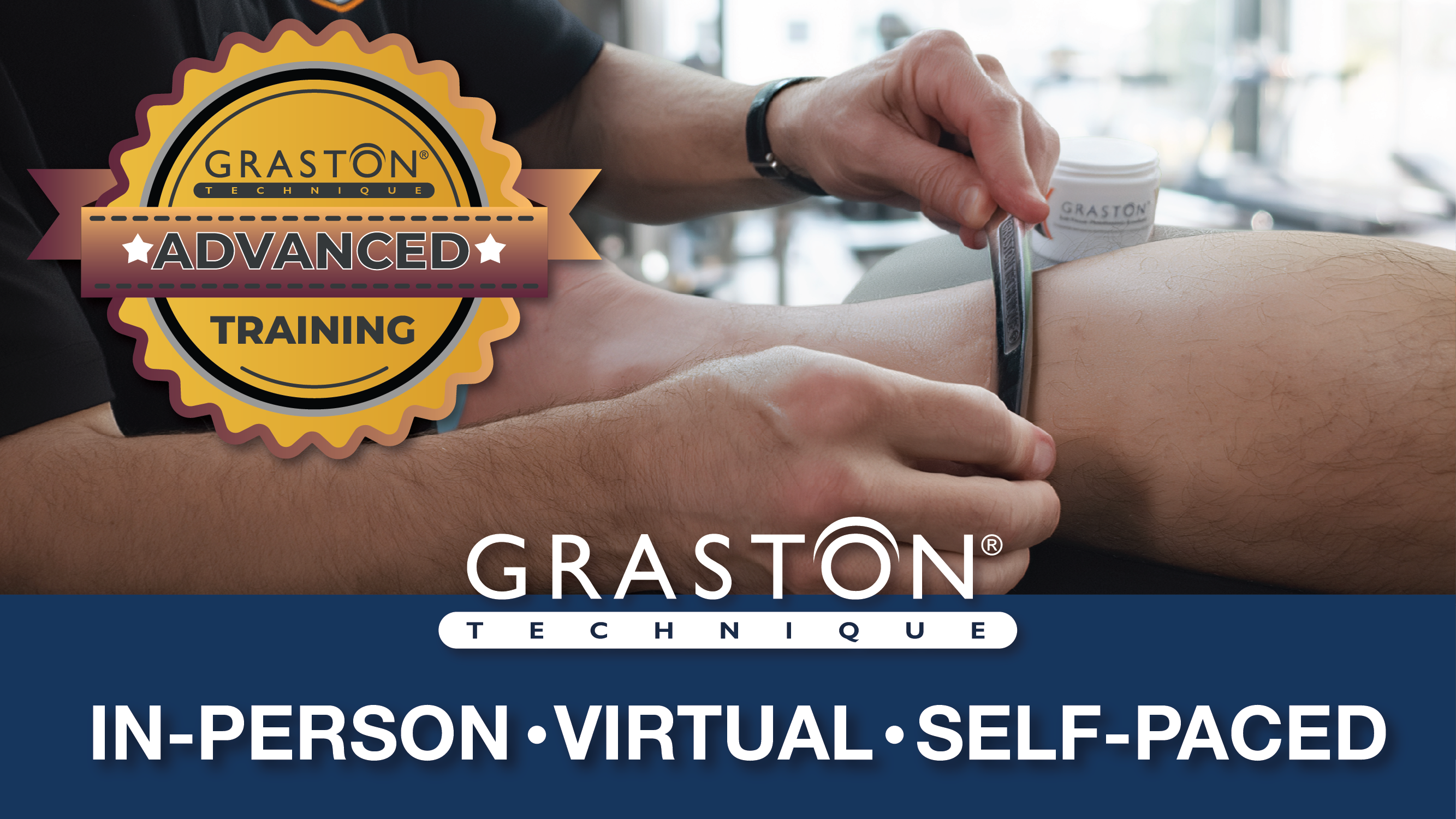
Advanced Training highlights the Graston Technique therapy examination and treatment approach for musculoskeletal dysfunction and mechanical pain that can be applied in all patient cases. This includes movement loss, lesion localization, and resistive testing. Preventative and corrective exercises to augment the GT therapy intervention will be discussed. In addition, we will introduce five new advanced treatment strokes.
Our Live In-Person Advanced Training is a 2-day intensive with 15+ hours of hands-on instruction. It begins with a self-paced online pre-course followed by two days of supervised labs with a GT instructor.
Complete the online pre-course in our learning portal before attending the in-person or virtual session.
Welcome and introduction to Advanced Training; principles relating to soft-tissue dysfunction; anticipated responses and results from using GT instruments on the human neuromyofascial system.
Review of each Graston instrument; proper handholds and treatment strokes; lab practice reviewing scanning, sweeping, strumming, brushing, swiveling, scooping, J-strokes, and framing.
Fascial physiology and structural considerations; indications and contraindications; documentation and billing; advanced treatment parameters; advanced treatment algorithm.
Demonstration and lab practice of additional Advanced strokes: IA Skin Rolling, C-Bowing, Fascial Spiral, Pin and Stretch/Glide, Interface Rock/Scoop — without and with movement and load.
Lunch break.
Functional testing and its role in determining dysfunction in the human neuromyofascial system; test/treat/retest; regional interdependence; SFMA as a means of detecting dysfunction.
Demonstration and lab practice of GT Advanced techniques to improve mobility and motor control of the cervical, thoracic, and lumbosacral spines.
Importance of breathing and assessment of the anterior abdominal wall and diaphragm.
Demonstration and lab practice of GT Advanced techniques for the abdominal wall, diaphragm, and anterior pelvis; scar mobilization and edema techniques with movement and load.
Review of Day 1 concepts, advanced algorithm, and Day 2 agenda.
Concepts related to tendinopathy and tendinosis; review of evidence regarding common interventions; GT Tendinosis Protocol demonstration.
UE and LE tendinosis assessment techniques; rotator cuff, epicondylosis, hamstring, patellar, and Achilles tendinosis; active learning lab with clinical cases.
Demonstration and lab practice of GT Advanced techniques to improve mobility and motor control of the upper extremity.
Mid-morning break.
Demonstration and lab practice of GT Advanced techniques to improve mobility and motor control of the lower extremity.
Active learning lab: clinical case treatment progressions based on concepts learned in Advanced Training.
Course wrap-up; questions and answers; course evaluation; adjourn.
Purchase a voucher now and apply it to any future Advanced Course in the format that fits your schedule. This Black Friday price is only available for a limited time.
Self-Paced, Virtual, or In-Person · 14 CEUs
Black Friday pricing ends Monday, November 30.
Advanced Training participants must hold a valid clinical license and must have successfully completed Graston Technique Essential Training. A working knowledge of functional anatomy, human movement analysis, and regional interdependence is recommended.
Self-Paced lets you complete the pre-course on your own schedule. Virtual pairs live online instruction with hands-on demonstrations. In-Person delivers two intensive days of supervised labs with a GT instructor.
Your Advanced Course Voucher does not expire. Apply it to any available future Advanced Training session in the format that fits your schedule.
For in-person sessions, bring comfortable clothing suitable for lab work. Instruments are provided during the training; many clinicians later purchase their own GT instrument set to use in practice.
Your order is confirmed. A receipt is on its way to your email.